Balmve buying guide · Updated 30 September 2026
Best collagen for joint pain? Start with the form and amount.
“Collagen” can mean a gram-dose peptide powder, a low-dose undenatured Type II ingredient, or a blend that hides the amounts. Here’s how to compare the label before you compare brands.

Want both collagen formats in one product?
See the full label, current offers and purchase choices on the Balmve product page.
“Collagen” isn’t one single ingredient
Hydrolyzed collagen peptides are collagen processed into smaller peptides. They’re usually listed in gram quantities. Undenatured Type II collagen is processed differently and is used in much smaller amounts. A milligram figure can’t be compared with a gram figure without checking the ingredient form.
Source and type are separate label details. A product can use bovine or marine collagen, and it can contain Type I, II or III. “Multi-collagen” tells you there is more than one type or source, but the full ingredient panel is where the amounts and sources should be checked.
Compare like with like
| Check | What to look for | Why it matters |
|---|---|---|
| Preparation | Hydrolyzed peptides or undenatured/native Type II | They are different forms, not interchangeable names. |
| Amount | Amount per serving and the serving size | A scoop size and a daily amount are not always the same. |
| Source | Bovine, fish or another source | Source affects dietary suitability and allergy checks. |
| Blend detail | Separate amounts where the label provides them | A total blend weight doesn’t show every component’s dose. |
| Evidence | Studies on the same preparation and amount | Evidence for one ingredient or formula doesn’t prove another product. |
Powder, capsule or drink?
Format is mainly a routine question. A powder can carry gram-dose peptides in one scoop; a capsule can be convenient for a lower-milligram ingredient. Compare the actual daily serving, total servings and directions rather than the container size alone.
What collagen research can and can’t tell you
Reviews of randomized trials report possible improvements in knee symptoms with some collagen preparations. The studies vary in formula, amount, participants and length, so the pooled result doesn’t prove that every collagen product works the same way.
Several trials of undenatured Type II collagen used 40 mg daily. That makes the amount worth checking on a label. It does not establish that a different amount, a different ingredient or a combined formula will produce the same result. Results vary, and persistent or worsening symptoms deserve a clinician’s advice.
Collagen supplements aren’t a replacement for diagnosis, prescribed treatment or appropriate movement and exercise. If you take medication, have a medical condition, are pregnant, or have an allergy to a product source, check suitability with a qualified professional.
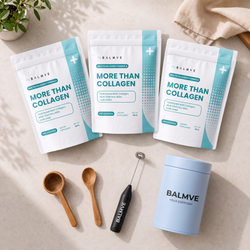
What’s on the More Than Collagen label
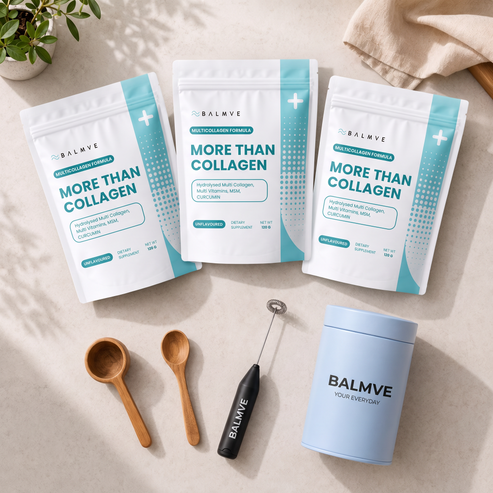
The live supplement facts show a 5 g one-scoop serving with 4,500 mg multi-collagen blend and 20 mg undenatured Type II, or a 10 g two-scoop serving with 9,000 mg blend and 40 mg Type II. The pouch contains 26 one-scoop servings or 13 two-scoop servings.
The blend lists bovine Types I and III plus marine Type I, without separate amounts by source. At 5 g, the label lists vitamin C (75 mg), vitamin D3 (12.5 mcg), vitamin K2 (50 mcg), and a 375 mg proprietary blend. At 10 g, it lists vitamin C (150 mg), vitamin D3 (25 mcg), vitamin K2 (100 mcg), and a 750 mg proprietary blend. Check the package for full ingredients, allergens and directions.

Check the product details
See the complete ingredient panel, current pricing and available purchase options.
Shop More Than CollagenBalmve sells the product discussed in this guide. Product claims are not medical advice.
Sources and further reading
- Updated systematic review and meta-analysis of collagen supplementation for knee osteoarthritis.
- Lugo et al., randomized trial of undenatured Type II collagen.
- Bakilan et al., randomized placebo-controlled trial of native Type II collagen.
- NICE guidance on osteoarthritis in people aged 16 and over.
This guide is educational. Supplements are not intended to diagnose, treat, cure or prevent disease. Ask a qualified healthcare professional about personal suitability.