Ingredient guide · A Balmve article
Type I & III vs Type II collagen: what changes on the label?
The Roman numeral names a collagen type. Words like “hydrolyzed” and “undenatured” describe how it was processed. Source, type and preparation answer different questions.
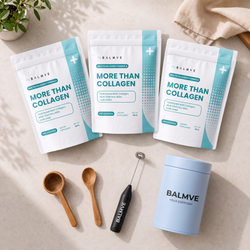
See how both formats appear on our label
Check current product details and choose from the available purchase options.
Three label terms, three different answers
Where it comes from
Bovine and marine identify the source. They don’t tell you how collagen was processed.
Which collagen
Types I, II and III are different collagen types found in different tissues.
How it was made
Hydrolyzed peptides and undenatured collagen describe different preparations.
These terms are easy to blur in a product name. Read the ingredient list and supplement facts panel together. A product can contain more than one source and type, and one type can be processed in more than one way.
Type I/III peptides and undenatured Type II compared
| Question | Hydrolyzed Type I/III-rich peptides | Undenatured Type II |
|---|---|---|
| What does the name describe? | Collagen type and hydrolyzed preparation. | Type II collagen in an undenatured preparation. |
| How much is commonly listed? | Usually gram quantities; study formulas vary. | Often tens of milligrams in published knee studies. |
| What do studies measure? | Different studies measure skin or joint outcomes, depending on the formula and population. | Some trials measure knee symptoms or flexibility. |
| What can you conclude? | One product’s result doesn’t prove every peptide formula will perform the same. | Evidence on an ingredient doesn’t prove a combined brand formula works the same way. |
The useful comparison is not “which Roman numeral wins?” It is “what form is in this product, how much does the daily serving provide, and what evidence matches that preparation and amount?”
What research says about Type II
Randomized trials have studied undenatured Type II collagen at 40 mg daily. Other collagen research uses different preparations, amounts and populations. A systematic review can combine multiple studies, but that does not make the products or findings interchangeable.
The current label lists 20 mg Type II at 5 g and 40 mg at 10 g. The study amount is useful context for reading the label, not a promise about what a product will do. One formulation’s trial results cannot be transferred directly to this combined formula.
What the live More Than Collagen label shows
At 5 g, the label lists 4,500 mg of multi-collagen blend, with bovine Types I and III and marine Type I, plus 20 mg undenatured Type II. At 10 g, it lists 9,000 mg blend and 40 mg Type II. Vitamin C, D3, K2, and the proprietary blend amounts also double between the serving panels. Separate amounts by collagen source aren’t shown.
The pouch has 26 servings at one 5 g scoop, or 13 servings at two scoops (10 g). Follow the directions and ingredient information on the package.

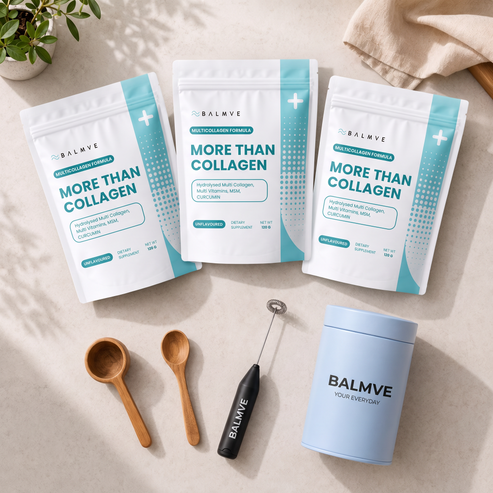
Review the full product page
See the current label, price and available buying options before choosing.
Shop More Than CollagenBalmve sells the product covered in this guide.
Sources and further reading
- Lugo et al., randomized trial of undenatured Type II collagen.
- Bakilan et al., randomized placebo-controlled trial of native Type II collagen.
- Schoenfeld et al., randomized trial of UC-II and knee flexibility.
- Updated systematic review and meta-analysis of collagen supplementation for knee osteoarthritis.
This article is educational, not medical advice. Supplements are not intended to diagnose, treat, cure or prevent disease. Ask a qualified healthcare professional about suitability.